Belize, where have you been all my life?

In Belize, I fell down a cliff into Tiger Creek, 20 yards from an 800-foot waterfall, ruined my new camera, nearly lost my lucky hat and endured pounding rain and roads as bumpy as political budget talks. Yet, I can’t wait to go back.

Romantic Waterfall Lunch

I’ve had a long and enduring love affair with Latin America. To each new country, I give my whole heart. But there have been problems. I can’t understand a single word anyone says.

I have tried to learn Spanish, have even mastered a few questions that, to my ear, sound pretty authentic. But the minute someone answers back, I panic and end up looking like the idiot gringo I am.

In Belize, because the official language is English, I could actually converse with locals. Instead of just exchanging smiles, I could share jokes, learn about their families and move the relationship beyond my normal ceiling of “Hola! Como Estas! Muy bien. Y tu?” It was magical, leading me to wonder, “Why in the heck haven’t I been to Belize before?”

This little country wedged between Mexico and Guatemala has everything a tourist destination could ever need: miles and miles of beaches, the second largest barrier reef in the world, 450 islands and Mayan ruins that are still being discovered.

Caracol, where I had intended to bring in the end of the Mayan calendar (long story, don’t ask), covers more than 30 square miles, much of which is still being excavated. At one time, this now jungle-covered city had more people than Belize City has today.

Majestic Caana (Sky Palace), one of 35,000 structures at Caracol, is still the largest building in the country, although the only residents today are a few security guards, some itinerant archaeologists and two troops of howler monkeys whose hoots are the spitting image of the soundtrack to Jurassic Park. Only a few feet from one of the troops, I captured their ongoing argument on video and would have added it to the bottom of this story except, as I said, the camera ended up submerged in Tiger Creek.

For years, no one even knew Caracol existed. Many of Belize’s Mayan ruins had been discovered by 1937 when a logger looking for mahogany stumbled upon this city, one of the largest in Maya civilization. It’s just that this mighty city was covered with vines and trees and other flora of the rainforests that make up nearly 60 percent of this Central American country.

When not monitoring feuds with howler monkeys, I stayed in one of 12 cottages at Hidden Valley Inn, a 7,290-acre private nature reserve, not far from Caracol. This intimate lodge in Mountain Pine Ridge has 90 miles of hiking trails, 12 waterfalls, 81 species of wild orchids, four species of jungle cats (although they’re nearly as hard to spot as Caracol was for so many years) and rare raptors. One night at dinner, I had the privilege of dining with a volunteer studying a rare nest of solitary eagles, one of many (Hidden Valley also supports the Peregrine Fund) on-site research projects. Another perk is Hidden Valley’s small coffee plantation. Not only was my morning java Fair Trade, but also locally-grown.

And it’s not just diversity of flora and fauna that makes Belize so enchanting. It’s a veritable fondue pot of cultures from Kriol, Maya and Mestizo to Amish and Mennonite, all of whom work amiably together to keep this little country humming. I saw giant truckloads of oranges, most of which would end up in Florida to make juice. I saw a barefoot Mennonite girl run, two steps at a time, to the top of the 140-foot Sky Palace. I saw lemon sharks, barracuda and a monstrous school of blue tang. I swam three-feet above a three-foot loggerhead turtle.

But, most importantly, I met dozens of friendly, warm, English-speaking Belizeans. One night, in fact, the owner of my Placencia hotel invited me to a party with his friends, opening the curtain to a precious part of Belizean culture most travelers miss. That Friday night, underdog Belize had miraculously made it to the semifinals of the Copa Centroamericana soccer tournament against Honduras, the first time the tiny nation qualified to play for the CONCACAF gold cup.

Evan Hall, the owner of Nirvana Inn, invited me to cheer on the home team by the light of a TV hooked up outside under a coconut tree. Whenever I needed another drink, he and his buddies reached up, plucked a coconut off the tree and mixed a little coconut water with Jack Daniels. The grill was piled high with fresh shrimp and lobster they’d caught earlier that morning.

So, yeah, Belize claimed my camera and my pride (luckily, no one saw my plummet down the cliff after the rain-soaked railing gave way), but it’s biggest claim is undoubtedly my completely-smitten heart.

I aint afraid o’ no ghosts…except in La Mesilla’s Double Eagle

There are dozens of reason to visit the Double Eagle in La Mesilla, New Mexico. It serves killer steaks (aged up to 80 days in a special aging room), boasts the world’s largest green chili cheeseburger (the bun alone is a foot wide) and whips up margaritas that would make even stone-faced John Boehner do the cha-cha. Just walking around this 1840’s adobe mansion with its 18- and 24-karat gold ceilings, baccarat chandeliers, 30-foot oak and walnut bar and Billy the Kid artifacts is a history lesson.

But the reason I can’t wait to go back to this national historic site near the Mexican border is I finally got requited proof that ghosts exist. I love hearing spooky stories, have always known there’s a lot more than this 70, 80-year span we call life. But I’m a skeptic. When it comes to believing the crazy episodes of Ghost Hunters or Most Haunted or whatever new ghost-busting show is out there, my response resembles a seventh grade girl reacting to her mother’s advice: “Whatever.”

But on a recent Saturday night, dining at the Double Eagle, I was thoroughly loving the stories about Armando and Inez, the star-crossed lovers who purportedly haunt the place, and decided to take the bait. Jerry Harrell, the manager, told us how Armando’s mother, a wealthy socialite, fired the enchanting Inez (she was their maid) after learning about their affair. But since teenage boys heed mom’s meddling in much the same way as teenage girls, Armando failed to break it off. One unfortunate day, the high and mighty senora found the sneaky teenagers in Armando’s bedroom, flew into a rage and murdered them both with a pair of sewing shears. To be fair, she didn’t intend to murder her son, but he was in love and gallant and well, he stepped in the way.

That’s the back story. More than 100 years later, after their sprawling home was turned into a restaurant, mysterious, unexplained things started happening: lavender perfume wafted down the halls, knives were stacked on the bedroom floor, chairs overturned and tables mysteriously moved overnight.

One of the employees, in fact, got so spooked that he insisted on a waiver in his contract promising he’d never be left in the restaurant alone. A short-lived assistant manager, who pooh-poohed the stories, jokingly left a bottle of wine and a couple glasses for the couple. He came back the next day, unhooked the security system and found an empty wine bottle and the glasses broken in the fire place. He threw the keys at the chef and said, “I quit. Mail my paycheck.”

Before starting desert, Jerry pointed us to the room, now called the Carlotta Salon, where the murder took place.

“Just don’t sit on their chairs,” he warned, explaining that “their chairs,” even after being newly-reupholstered, have indentations where the teenager lovers sit. “Inez and Armando are harmless, just normal teenage pranksters. Unless, you make them mad by sitting in their chairs.”

Even though I don’t hold a lot of stock in such stories, I figured I might as well, out of ghostful respect, steer clear. But Lindsey, my co-conspirator, plopped right down in Inez’s chair. (You can tell which is which because dresses make different indentations than pants). Far be it from me to wimp out, I gingerly crept towards Armando’s chair and quickly edged into his seat.

Not three seconds later, the nearby lamp’s hand-cut glass crystals began shaking violently. And, no, I didn’t touch it. The table on which it sat was a good three feet from me and even though I’m tall, further away than my arm span. I wasted no time. I jumped up, ran for the door and pulled Lindsey with me. She was busy snapping pictures with her I-Phone.

“You did see that, right?” I said.

“Oh, yeah!” she assured me, adding that the air around her turned ice cold the moment she sat down.

We rushed back to the dining room to inform our party about the weird phenomenon. Most of them laughed and parroted my old response.

“No really,” we insisted. “Look. Lindsey took pictures.”

She held out her I-phone and all 58 of her photos (I can verify. I heard her phone going click, click, click) were gone, completely wiped out.

“I told you,” Jerry said. “You shouldn’t have pissed them off.”

The perks of being a Virgin Galactic Bransonaut

I’m on rutted, dirt roads in the Jornada del Muerto desert of southern New Mexico headed to Spaceport America, the world’s first purpose-built commercial spaceport. It’s adjacent to White Sands Missile Range where, for 70 some years, assorted rockets, nuclear bombs and other WMDs have been tested.

My useless GPS reports this 3,200 square miles of restricted air space as one monstrous black hole. I’d have never found Spaceport Operations Center (SOC, for short) or Virgin Galactic’s Gateway to Space if it wasn’t for Aaron Prescott, the rocket scientist whose college friends can’t help but break the tenth commandment: “Thou Shall Not Covet.”

They’re insanely jealous, he says, of his position as Business Operations Manager for New Mexico’s $209 million entry into global commercial spaceflight. He works with madcap entrepreneur Sir Richard Branson — whose left eye is on the security badge required to get into the New Mexico Space Authority (NMSA) — and other aerospace firms contracted to fly from this remote high desert location. Prescott calls it the Kitty Hawk of space travel.

Since 2006, 17 rockets have been launched here — “Unmanned, so far,” Prescott says. “We want to make sure people are buying roundtrip tickets.” — and 551 have slapped down $200,000 for Virgin Galactic’s three days of astronaut training and two hours in space. ‘Course, that’s chump change for the likes of Ashton Kutcher, Justin Bieber and Kate Winslett, to name a few of the already-paids who probably make that in, say 10 minutes of “Two and a Half Men.”

Mixing it up with celebrities is just one of the perks. Here are five more:

1. Free Drinks at the Astronauts Lounge. When you’re Katy Perry, another who forked over $200 grand, you tend to travel with an entourage. Minions are more than welcome to hang out at the Spaceport, clap when you blast off, even follow your every G-force on giant monitors — “We could probably configure the flights with an iPhone app,” Prescott says, “But you gotta put on a show.” — but the spacesuit dressing room and third-floor lounge with the free champagne? That’s for Bransonauts only.

2. Five minutes of being weightless. Much of the two-hour flight involves getting to the other side of the Karman Line, the line that divides earth’s atmosphere from outer space. But at 60 miles up, you can see 1,500 to 2,000 miles in all directions or, to put it in perspective, that’s a view of the Pacific Ocean and the Gulf of Mexico at the same time.

3. No need to be a perfect specimen of humanity. Qualifying for NASA requires brains like Einstein, 1,000 hours of in-command flight time and the ability to pass a rigorous physical. Only an elite few make it in. As a Bransonaut, you don’t even need a pressure suit. “At three and a half to six Gs, it’s like a really awesome roller coaster,” Prescott says, adding that at nine Gs, you’d black out.

4. Bragging rights. Being the first to get your Boy Scout “Space Badge” is nothing compared to the VIP invitations to Branson’s private Caribbean island home or his South African game reserve. Last year, for example, he held an Astronaut Forum, a tour of the LEED Gold 110,000-square-foot Virgin Galactic terminal and dinner at Mesilla’s historic Double Eagle steakhouse.

5. 360-degree skies. I’d pit the sunset in southern New Mexico to any painting in any art museum anywhere.

For the rest of us, Follow the Sun offers a three-hour, $59 bus tour.

Pam Grout is the author of E-Squared, 9 Do-it-Yourself Energy Experiments that Prove Your Thoughts Create Your Reality. Find out more at www.pamgrout.com.

In a smackdown of Belize inns, the top 6 reasons Belizean Nirvana outshines Coppola’s Turtle Inn

Francis Ford Coppola makes insanely brilliant movies. He’s done wonders for the economy of his adopted country of Belize, building two five-star resorts that are every bit as wonderful as The Godfather and Apocalypse Now. But here’s why, when traveling to Placencia, the 16-mile strip of beautiful off the southern coast, the Belizean Nirvana (the envelope, please) deserves the Oscar:

1.Location, location, location. Both Turtle Inn and Nirvana are “pan da beach,” as they say in Belize, a gorgeous beach with white sand, diving pelicans and gentle lapping waves. But Nirvana, that just opened September 2011, is also within strolling distance of the quaint and colorful fishing village where Evan and Barbara Hall, the Belizean owners, personally introduce their guests to Tiziana and Lorenzo, the Italian transplants who own Tutti Frutti and serve gelato some rave is better than its counterpart on the other side of the Atlantic, and to John and Pamela Solomon, Americans who honeymooned there five years ago and never left, instead opening the amazing Rumfish..y vino that serves my nomination for the world’s best cerviche.
2. Hand’s on owners. Sure, it’s fun to think you’re sleeping near Hollywood greatness, but your chances of hobnobbing with Coppola are about as good as your chances of spotting one of the 200 jaguars in the nearby Cockscomb Jaguar Preserve which is to say “it ain’t likely to happen.” The Halls and their friend, Carolyn, greet each of their guests upon arrival, drink coffee with them each morning (one morning, Evan even cracked open a bottle of champagne for delightful breakfast mimosas) on the rooftop deck and treat them like one of the family.
3. It’s who you know. Coppola may knows DeNiro, Pacino and Reese Witherspoon who honeymooned at Turtle Inn in 2011 with her new hubby and kids. But Hall knows Tuca and Karen, Steve and Sherel and other locals and he’ll gladly introduce you, opening the curtain to a precious part of Belizean culture that most travelers miss. Belizeans are warm, friendly and throw parties that put Martha Stewart to shame. Hall’s mother was the first nurse in the Belizean Health Service and even though he spent much of his life in New Jersey, he summered in Belize and knows everybody in town.
4. Improptu fun. The Friday night I was there, underdog Belize miraculously made it to the semifinals of the Copa Centroamericana soccer tournament against Honduras, the first time the tiny nation qualified to play for the CONCACAF gold cup. Hall invited me to watch the game with the above forementioned locals who were cheering the home team by the light of a TV hooked up outside under a coconut tree. Whenever I needed another drink, they’d reach up, pluck a coconut off the tree and mix a little coconut water with Jack Daniels (American bartenders, take heed). The grill was piled high with fresh shrimp and lobster that Tuca had caught earlier that morning. Suffice it to say, the food made by that outdoor cheering squad far surpassed anything listed on the menu at Turtle Inn’s three restaurants.
5. Classy appointments. Like the Coppolas who built their 25 thatched cottages on reclaimed land from Hurricane Iris, the Halls built their five-suite B&B from scratch. It has beautiful wood floors, spacious verandas, gorgeous furnishings, local artwork (again, Evan might even introduce you to some of the artists), comfy beds and unlike Coppola’s place, air-conditioning that comes in mighty handy in the humid climate and free phone calls to the U.S. and Canada.
6.The real deal. Far be it from me to dis Turtle Inn. I’m sure it’s spectacular in every way. But for travelers who want an authentic Belizean experience and new friends to add to the Christmas card list, book one of the beautiful suites at Belizean Nirvana Inn.

Kanye one-ups Kim on her 32nd birthday

It’s pretty tough to top a $750,000 Lamborghini, the birthday gift Kim Kardashian gave to Kanye West on his 35th birthday last June, but the controversial rapper managed to pull it off with a birthday weekend at Venice’s Hotel Cipriani.

This historic hotel whose gardens were once the stomping grounds for Casanova himself was the perfect b-day getaway for the reality star who’d been working long hours (do socialites really work long hours?), dealing with Kris Humphries, her stubborn ex of 72 days, and pining over the prospects of turning 32.

To get to the Cipriani, located just across the lagoon from St. Mark’s Square on Giudecca Island, one of a hundred islands that make up Venice, the lovebirds boarded “Shirley,” the sleek mahogany yacht that transports guests of this iconic Orient-Express hotel back and forth to San Marco pier.

They were greeted by Roberto Senigallia, the Cipriani’s charming, flirtatious one-man welcoming committee and introduced to concierge, Gigi Racanelli, who like all the decades-long employees of this venerable property, make you feel like part of the family.

Gabbiano Bartender Walter Bolzonella has even been known to concoct new drinks in your honor. Just ask George Clooney whose film “Good Night, and Good Luck” and his mother, Nina, both have cocktails named after them. The first, the Buona Notte (half a lime, fresh ginger, a spoonful of cane sugar, angostura bitter, vodka, cranberry and crushed ice) was invented in 2005 when Clooney’s film appeared at the Venice Film Festival and Nina’s Special, the one named for his mother, was created six years later, another time Italian fanatic Clooney stayed at the idyllic paradise.

Of course, it’s only fitting. Hotel Cipriani was started by Giuseppe Cipriani, the famous barman who founded Harry’s Bar in 1931. Until then, he worked at Venice’s Hotel Europa where he met Harry Pickering, a young Bostonian whose wealthy family cut him off for too much partying.

Giuseppe, who viewed the young heir’s hobby differently, loaned him 10,000 lire (roughly $5000) to continue his studies. Two years later, long after Cipriani had given up on ever seeing the young student again, Pickering returned to Venice and bequeathed the man who didn’t give up on him, enough money to start Harry’s Bar. It became a favorite of Ernest Hemingway (Cipriani said Hemingway was very generous and wrote more checks than he did words at his private table), Humphrey Bogart, Charlie Chaplin, Somerset Maugham and other notables of the day. It’s also where the Bellini cocktails and carpaccio were invented.

So, it’s not surprising that in 1958, when Cipriani turned the 15th century Palazzo and gardens where Casanova used to sneak off with daughters of Venetian royalty into a namesake hotel, that celebrities continued to flock. During the Venice Film Festival, in fact, it’s next to impossible to get a room with the likes of Steven Spielberg, Leonardo DiCaprio, Meryl Streep, Tom Hanks and Gwyneth Paltrow hogging bookings and,in Paltrow’s case, raving about its “perfect pasta pomodoro.”

Although we don’t know exactly in which of the Capriani’s fabulous suites Kanye sang “Happy Birthday” to his now-pregnant wife, we do know it had a romantic view of the Canaletto overlooking St. Marks, period furniture, guilded ceilings, Murano glass, travertine marble, silk curtains, Fortuny lamps, hand-made stuccos, a personal butler and access to Casanova’s gardens, now filled with Italian sculptures. And we’re pretty sure they had made at least one toast with Bellinis, the famous drink Giuseppe Cipriani created in 1948, named after Renaissance painter Giovanna Bellini and made with fresh white peaches and prosecco.

It’s no wonder Kim tweeted, “Italy is so beautiful. Best birthday ever.”

South Dakota’s Buffalo Trample Politics

In the flurry up to the November 6th election, most of us missed our country’s first National Bison Day. It was commemorated on November 1, five days before Republicans and Democrats slugged it out at the polls.

2012-12-03-buffaloresize.jpg

While it’s not clear how one celebrates National Bison Day, I do know pending legislation to designate this stupendous beast that once roamed our country in herds as big as Rhode Island as our official national mammal has proven that elected officials on both sides of the political spectrum can still agree on something

In fact, bills (S. 3248, introduced May 24, and H.R. 6304, introduced August 2) were put forth by Congressmen on both sides of the aisle with co-sponsors from both parties. Yes, an “R” and a “D” on the same bills gives me hope that, just like the bison that rebounded from a straggly herd of 15 at the Bronx Zoo, our cantankerous old Congressmen will eventually come together and do something meaningful.

In the meantime, I went to South Dakota for Governor Dennis Daugaard’s annual Buffalo Roundup. Held at Custer State Park for nearly 50 years, this spectacle involves 1,300 snorting, hairy beasts running across the prairie at speeds of up to 50 miles-per-hour, and cowboys on horses with real chaps and spurs trying to corral them into a giant pen. If it’s not on your bucket list, get it on there fast. It’s truly something to see.

Custer State Park is big (71,000 acres), so you can imagine the task of just finding 1,300 bison — roaming free as they do through the granite spires of Needles Highway, along the park’s 18-mile Wildlife Loop and near Sylvan Lake, the mountain lake sitting at the base of Harney Peak, the highest point east of the Rockies — let alone getting the headstrong creatures to cooperate by running into a pen where they will be inoculated, branded (if they’re calves), culled and either chosen for November’s annual auction that raises some $325,000 for the South Dakota Department of Parks and Recreation or released back into the wild beauty of this park, one of many on the west side of South Dakota.

2012-12-03-custersign.jpg

Between state parks, national parks and national monuments, this part of our country is one big protected Kodak moment after another. There’s the Badlands, the Black Hills, Mount Rushmore, Jewel Cave National Monument (with the second longest cave in the world), Wind Cave National Park, Crazy Horse Memorial, Spearfish Canyon, Bear Butte State Park where indigenous Northern Plains tribes go for vision quests and, of course, the magnificent Custer State Park that served as the summer White House for Calvin Coolidge.

For anyone who a) longs to get up close and personal to nature (besides the bison, Custer State Park has elk, bighorn sheep, mountain lions, mountain goats, pronghorn and a herd of 50 feral begging burros who practically climb in your mini-van in search of bread and other treats that they know to expect), b) feels inspired by the possibilities of the human spirit (Gutzon Borglum spent 14 years hanging from ropes while he jackhammered and blasted out Mount Rushmore, and he didn’t even start until he was 60) or c) cheerleads the greatness of our country (American patriotism is the overriding soundtrack in Western South Dakota), should plan a trip here soon.

As for the bison (that once thundered across the plains to the tune of 30 million head), if those bills pass, it will join the Bald Eagle (our official bird since 1782), the rose (our official flower) and the oak (our official tree).

Everything I wanted to know about Russia, I learned in a vodka bottle

When it comes to vodka, the Russians don’t mess around. They write dissertations about it (Dmitri Mendeleev, the chemistry professor who invented the Periodic Table of Elements, established its precise 80-proof formula in 1894), they create monopolies over it (Tsar Ivan III protected it as early as the 1470s only then it was known as “hot wine,” “bread wine” or “green wine”) and they drink it. Straight up. In shot glasses. In one brave swig.

vodkaresize

Russian billionaire Roustam Tariko, the entrepreneur behind Russian Standard, Russia’s largest vodka maker, recently made headlines for forking over a whopping $3 million for the rights to own vodka.com. That’s $375,000 per letter.

Indeed, vodka has played a crucial role in the history of Russian civilization from its production in 15th-century monasteries to fundraising for Peter the Great’s reforms, from lost military battles (Stalin’s daily rations became known as Commissar’s 100 Grams) to Gorbachev’s ill-fated attempt to curtail its consumption, an unilaterally unpopular campaign that was abandoned within two years.

So you won’t be surprised to hear that I downed a sizable portion of Russia’s national drink on a recent river cruise between Moscow and St. Petersburg. The crew on the Scenic Tsar, a new boutique ship, the first new build since the Soviet thaw, even went so far as to teach me how to balance a shot glass on my elbow, drink without my hands and finish an entire bottle in one sitting, an absolute necessity if you don’t want to offend your Russian hosts.

The comforting news, at least for those who care about my (hic) welfare, is that each bottle of vodka is meant to be shared between three friends, a tradition started during Kruschev times when a joint investment of a ruble apiece could buy the standard 500 milliliter bottle. Of course, there was also a time after the Soviet collapse when the ruble was basically worthless and the currency was vodka. But that’s another story.

To properly drink vodka, you’ll also need brown bread, salted fish and pickled veggies, especially pickled tomatoes. You swig a shot (sipping is strictly forbidden) after which you nurture your burning throat with the bread and salted, pickled accoutrements. Usually, there’s an accordion, a balalaika and at least one exuberant Russian (oftentimes more) singing “Kalinka,” the upbeat Russian folk song that has been appropriated by everyone from the Chelsea Football Club to the German pop group Yamboo to Call of Duty: Modern Warfare 2.

To make it even more fun, vodka in Russia is not just vodka. There are literally thousands of flavors. Sophisticated gourmands consider it a point of honor to try flavors beginning with all 33 letters of the Russian alphabet — acorn, blackberry, caraway seed, dill, etc. — and bottled in all manner of shaped glass — guns, swords, crowns, statues of Stalin, etc.

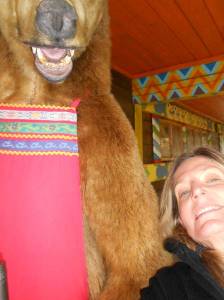
And then, when you’re properly sloshed, as we were in Mandrogi, a fairytale wooden village on the northern banks of Lake Ladoga where we enjoyed an exquisite four- or five-course feast, you stumble over to a Vodka Museum, one of several in Russia, and pay homage to the beverage Catherine the Great reserved for the exclusive production of the aristocracy. Whether there’s really a stuffed bear at the entrance wearing an apron and holding a tray, that’s probably more than I can rightfully claim. I am a journalist, after all, and wouldn’t want to spread any blurry facts.

bear resize

A 15-day package on Scenic Tours sleek, luxury-laden Scenic Tsar includes four nights in both Moscow and St. Petersburg and all (well, nearly all) the bottles of vodka you can drink.

For more information visit scenictours.com or call 866-689-8611.

# # #

Pam Grout is the author of E-Squared, 9 Do-it-Yourself Energy Experiments that Prove Your Thoughts Create Your Reality. Find out more at http://www.pamgrout.com.

“Occupy” your next vacation

Vacations, as we all know, cost money. And somebody benefits from the dollars we expend to “get away from it all.” So here’s my question: Would you rather line the pockets of the big corporations who run the major hotel chains, or would you instead like to use your buying power to support little guys who are trying to change the world?

For example, there’s a treehouse lodge in Laos — you have to zipline in to get there — where all proceeds go to save endangered singing gibbons. Or consider Lied Lodge, an eco-friendly spa in Nebraska, where 100 percent of profits benefit the National Arbor Day foundation. Likewise, Untours, a travel company in Pennsylvania, uses all its proceeds to fund low-interest, start-up loans to worthy organizations.

Here are four amazing vacations where 100 percent of your travel dollars support a good cause.

Promote social and economic justice by staying in an old stone farmhouse in Tuscany, a charming cottage in Provence, an apartment with a view of Prague’s Charles River or one of 20 other “live like the locals” tours provided by Untours, a Pennsylvania travel company that gives 100 percent of its profits to fund low-interest, start-up loans. Untours specializes in one to two-week stays (most in Europe, but a few in South America) that deeply immerse customers in their destination of choice. For example, if you choose Switzerland, you’ll stay in a hillside chalet, visit family-run cheese farms, hear yodelers and cowbells and, if you want, hang out with the host family. The point is, it’s up to you.

As for fighting poverty, Hal Taussig, founder of Untours, decided many years ago he didn’t want to accumulate capital. He and his wife Norma live in a tiny house, he rides a bike to work and he gives away 100 percent of Untour’s profits to innovative projects that address poverty around the world. For example, Untours funds Fonkoze, a microlender that gives loans to the poorest of Haiti’s poor. After the 2010 earthquake when Port-au-Prince’s nine commercial banks were in shambles and Western Union was paralyzed, 21 of Fonkoze’s agencies were already providing small loans that meant survival for thousands of Haitians. Untours funds 40 unique projects around the world from Greensgrow, a hydroponic vegetable grower in Philadelphia run by single moms, to a vegetarian restaurant in Saigon that supports street children.

Fight global warming at a spa in Nebraska City. Lied Lodge, a green hotel and convention center on the grounds of the Arbor Day Foundation’s tree farm, plows all profits from its spa and award-winning hotel into planting trees and promoting environmental stewardship. The hotel and spa are gorgeous with big fireplaces and luxurious rooms and there’s plenty to do: hiking trails, a tree house adventure, birding tours, wine tasting and, of course, sightseeing at the farm and the greenhouse where tens of thousands of seedlings are being grown for the Arbor Day Foundation’s million plus members.

Save endangered singing gibbons. In 1997, black-cheeked crested gibbons, which everybody thought were extinct, were rediscovered in a remote primordial rain forest in northern Laos, just across the border from Thailand. At Bokeo Nature Reserve, you can not only help save these endangered gibbons, but you can stay in an open-air treehouse and hear them sing. Bokeo’s treehouses have running water, beds, showers and meals cooked by Laotian chefs who zipline over to your treehouse three times a day with steaming bowls of sticky rice, fish soup, laap (a cousin to steak tartare) and other exotic Laotian dishes they’ve concocted over the village fire. All proceeds from this vacation go to protect the Bokeo Reserve and its melodious gibbons.

Support higher education. At Swans, a boutique hotel in the heart of “Old Towne” Victoria, British Columbia, guests can rest easy knowing their dollars are going to support students and research at the University of Victoria. Once owned by a local real estate magnate, this luxurious hotel was willed to the university after he died. With 30 suites (average suite is 500 square feet), 1,600 pieces of art and a well-regarded brewpub, this hotel is the place to stay when visiting Victoria and its famous inner harbor.


If you’re going to Branson, Mo., you can stay at the Keeter Center, a luxurious lodge with 15 suites, all lovingly attended to by the students at the College of the Ozarks. Students in the hospitality program deliver sumptuous breakfasts each morning with pastries they’ve made in their own on-site bakery and yogurt they’ve made at the college dairy. At night, they bring homemade cookies and milk, again straight from the very cows grazing outside your back window. Students get free tuition to the college in return for 15 hours of work.

Leave civilization behind in the Brazilian outback

Early adopters, listen up! You’ve got about three and a half years to get to Brazil before the crowds descend on the 2016 Summer Olympics. The Rio Olympics is the first ever in South America.

2011-03-01-gawlerranges.jpg

In other words, the getting’s ripe to bone up on a country that’s soon to be on the tip of everyone’s tongue. And while Rio, its beaches, babes and brazen Carnival have always been a tourism magnet, Brazil is a huge country with four time zones, a big chunk of Amazon jungle and a new state that’s not even 25-years-old.

The Tocantins (Portuguese for toucan’s beak) became a state in 1988 and unlike most of Brazil’s states that capital in colonial cities, this new kid on the block has a capital that two decades ago was nothing but pristine Savannah. Not only does Palmas, the gleaming new capital, have a giant hydroelectric dam that provides electricity to a large swath of this large country, but it also happens to be a popular rendezvous spot for Brazilian ecotourists. I recently had the privilege of taking a week-long safari in Jalapao, an amazing region just 150 miles from Palmas.

If the name Jalapao sounds vaguely familiar, it’s because Season 18 of Survivor was filmed in entirety at the very safari camp where I bunked beneath cashew and mangaba trees. With a comfy tent complete with mattressed-cot, I had to question the “reality” of the term “Survivor.” Hot showers, shaded campsite powered by solar generators and titillating meals could vie with any Hilton.

Korubo Safaris (named after an indigenous tribe undiscovered until 10 years ago) runs the safari camp on Novo Rio, a still drinkable river where guests kayak, swim and paddle around in inner tubes after exciting days tracking jaguars, panthers, monkeys and birds you only see on a cereal box. Yet to be discovered by Americans, Korubo mainly draws affluent travelers from Rio and Sao Paulo, all of whom know rudimentary English but had no real reason to use it except to occasionally humor the clueless American. Let’s just say if it had been “Survivor,” I’d have been the first voted off “the island.”

That’s not to say the Brazilians weren’t welcoming. They bent over backwards to include me in daily activities from hikes through the flat-topped Chapada Mountains to game treks in our open-air, double-decker jeeps. Using halting English, they even asked me polite questions, chief among them being “What is a single girl doing this far from home?”

The only real problem is the jokes went right over my non-Portuguese-speaking head and most of the time I felt like a geeky second grader not allowed to participate in the non-stop joie de vivre so common with carefree Brazilians. At dinner, fabulous feasts from local produce, I mostly smiled and continuously bugged the one German to translate the name of the many fresh juices offered with each meal.

2011-03-01-toucans.jpg

On the daily safaris, the Brazilians (and the one weird American) snapped photos of wildlife, got sprayed by towering waterfalls, swam in springs surrounded by banana trees and bought handicrafts woven from capim dourado, a rare golden grass that grows only in the Tocantins.

But for me, the best experience was the last night of the seven-day safari. After singing Beatles songs at the top of our lungs (some things transcend borders) as we bumped along the rutted trail, we hiked to the top of the Jalapao Dunes, famous for eerily changing color each night as the sun bids adieu.

2011-03-01-rionovo.jpg

Finally getting up the courage, my fellow safari-ites asked if they could borrow my by-now familiar khaki hat. It seems every single one of them, some of whom I’d only nodded and smiled at for the first six days, wanted to have their picture snapped with this popular photo prop. Who knew my ratty hat (they called it a chapeu) would wedge open the door that all my inept “bom dias” and “obrigadas” failed to budge?

I smile as I think back to that amazing week in the Brazilian outback, happy to know that in computers all over Sao Paulo and Rio are downloaded photos of my safari chapeu on the heads of my glorious traveling companions, still probably wondering “Who was that weird American?”

For more information on a truly one-of-a-kind safari, click here.

Antonio Ballatore goes green near Mount Rushmore

What do you get when you combine wild child designer Antonio Ballatore with Mount Rushmore, an old Radisson Hotel and a couple long-time hoteliers who want to reduce the footprint of the hospitality industry?

2012-11-30-MountRushmore.jpg

One of the most exciting hotel concepts since Travelocity simultaneously introduced the Green Guarantee and slapped a peace sign on the Roaming Gnome’s pointy hat.

“Most of the cooler materials are green anyway,” says Ballatore, who worked with Rapid City, South Dakota’s, Adoba Eco Hotel to create a brand new concept in green hotels. “Transforming an existing hotel into LEED-certified lends itself to a lot of cool materials, like recycled rugs and wood, and you gotta love all the inspiring artists and craftspeople doing this work.”

Indeed, the oh-so-chic Adoba Eco Hotel makes use of recycled snow fences from Wyoming, recycled soda caps for chandeliers, recycled water bottles for duvets (they’re super warm and comfy), old road sign for trash cans and serving trays and sheets made from eucalyptus. And while all of these design elements contribute to the hotel’s eventual goal of net zero energy, they also make the Adoba concept, like Ballatore himself was once described, “the Lady GaGa of hotel brands.”

Other badass, but more under-the-radar, features of Adoba include solar-thermal water and heating, low flow water fixtures, LED lighting, waste that’s compacted and baled, and the Enigma organic restaurant with Greener Planet wines and dishes such as Buffalo Carpaccio with grass-fed local buffalo, prickly-pear oil, fig balsamic and micro greens.

Even the building itself is recycled, having served 15 years as a Radisson in the South Dakota town that serves the Mount Rushmore set.

As owner, Karim Merali says about his decision to be the first to try this new concept in sustainable hospitality, “If you care, it takes a little more effort. You recycle, you treat your environment with respect.”

2012-11-30-mountrushmore2.jpg

But even more convincing, say James Henderson and Adrienne Pumphrey, the husband and wife team rolling out the new eco-friendly hotel brand, is the bottom line.

“The great thing about going green is that very quickly, by the second or third profit and loss statement, owners notice significant savings in energy consumption, water consumption and waste output,” Pumphrey says. “And customer engagement is off the charts.”

Although Adoba is just launching (their second hotel opened in Dearborn, Michigan on November 1), they’re projecting first year savings of 15 percent energy consumption, 8 percent water and 12 percent waste output. Over time, that can make a significant dent in the 40 percent of fossil fuel energy that’s consumed by traditional buildings.

They’re even working on a rewards system that gives guests bonus points for not taking 45-minute showers and remembering to turn off their curling irons.

“It’s part of our Stash Rewards. We have a system that measures and tracks energy use. Guests who don’t leave the water running, who don’t require daily sheet washing, get, say, an extra 250 points for water conservation,” says Pumphrey, who before rolling out this sustainable hotel plan spent 25 years working for such corporate hotel brands as Marriott, Hilton and Sheraton. “Somebody has to become a leader. Because we’re small and nimble, we can make these changes quickly.”

On tap in the next few months are four new Adoba Eco conversions (transforming existing properties such as the former Hyatt in Dearborn) and groundbreaking on a new build in Denver.

“We’re not just hoping just to change the hotel industry, but to save the world.” Pumphrey says.