Five reasons to beat the Pope to Egypt
Pope Francis is heading to Egypt the end of April to visit President Abdel-Fattah el-Sissi and the Grand Imam of the Al-Azhar.

 Here are five reasons every savvy globe-trotter should try to get there first.
1. Egypt is a bargain right now. Last November, Egyptian Central Bank devalued its currency by 48 percent. So everything’s cheap, cheap, cheap. I visited four weeks later and couldn’t believe the prices: gorgeous scarves for $3, an hour-long horse and buggy ride in Luxor for $4, luxury hotels for $50.
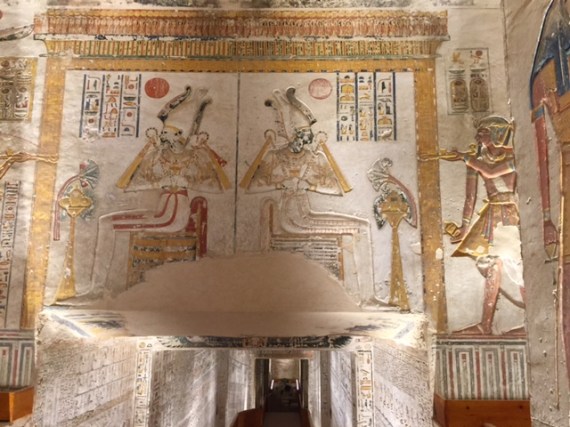
2. You get Ramses IV and King Tut to yourself. Thanks to events I need not recount here, tourism to Egypt has been down the last few years. The lines to enter the Great Pyramid of Giza and Luxor’s Valley of the Kings are non-existent. My daughter and I enjoyed the guilty pleasure of standing alone in Ramses tomb, being able to ogle the hieroglyphics and gilded sarcophagus with no pressure to move along for the next ogler. It’s truly a magical time to be in a truly magical country. Yes, some of my news-addicted friends worried for our safety, but I felt completely at ease, never threatened in any way. The news media does all of us a great disservice in its nonstop reporting of anomalous events. To give some perspective, what tourist would now avoid Charleston because of one fanatic racist? Again, look up the definition of anomaly.
3. Ancient antiquities are still being found. Less than two weeks ago, a nearly 3000-year-old statue was found under mud in a Cairo slum. The 26-foot (that’s nearly three stories tall) yet-to-be-identified statue made international headlines, but according to Khaled al-Anani, Egypt’s antiquities minister, only 30 percent of Egypt’s glories have yet been unearthed. That means 70 percent of who knows what is still buried under the sand. A couple years ago, for example, in Saqqara, two dozen mummies turned up in a 36-foot shaft. The point is, the excavation is just beginning. It’s like being in Silicon Valley in the 90’s.
 4. Locals are warm and welcoming. Perish any notion you might have about Middle-Easterners not liking tourists. It’s a myth, kinda like the Easter Bunny. Upon arrival in Cairo, it took a grand total of 15 minutes for me to realize this stereotype is misguided and downright insulting. Hospitality is an art in the Muslim world, a cherished virtue that encourages practitioners to view every person who comes across their path as sent by Allah himself. After spending a couple weeks with Sarwat Hegazy, a long-time guide and co-creator of Egypt Unveiled, any crusty idea I might have had about being unwelcome were quickly dashed against the seven-story granite sides of the infamous Sphinx.
Sarwat’s partner, Jane Bolinowsky, an Australian flute player who bought a second home within sand-blowing distance of the Giza Pyramid, knows all kinds of fascinating folks. Each of their tours are custom-designed, but expect to meet belly dancers, costume makers, perfume purveyors and Egypt’s best koshari chefs.
5. You get a priceless chance to uplift the world. Pope Francis, of course, is going to Cairo to cement the “spirit of tolerance and dialog,” to continue thawing Catholic-Muslim relationships that began when he lovingly embraced the Imam during last May’s visit to the Vatican. Seems to me, there’s very little more important that any of us could do than to hug our foreign brothers and realize we are all the same.
 March 21, 2017
 psgrout


 According to legend, Alexander the Great made it to Siwa in 332 BC by talking with snakes and following crows across the desert. He traversed the 150,000 square mile ocean of sand to consult with the Oracle of Amon, the great Sun God who is honored with a 3000-year old temple that stands yet today. Unlike Mr. Great, who was told by the ancient Oracle that he was the Divine Big Cheese and the rightful head of the gods and Egyptian pharaohs, I was told I should keep writing books.
 Even though it’s now possible to safari out into the Great Sand Sea, finding words to describe the experience is virtually impossible and, for my money, the genesis of the phrase, “You really have to be there.” The dictionary has yet to add words that can adequately describe the pure hugeness, the expanse, the colors, the sounds, the thrill of roller-coastering up and down the dunes as fast as your jeep will drive. Even photos, with their 1000-word value, can’t convey the experience, the immersion of silence found in this ocean of soft white sand.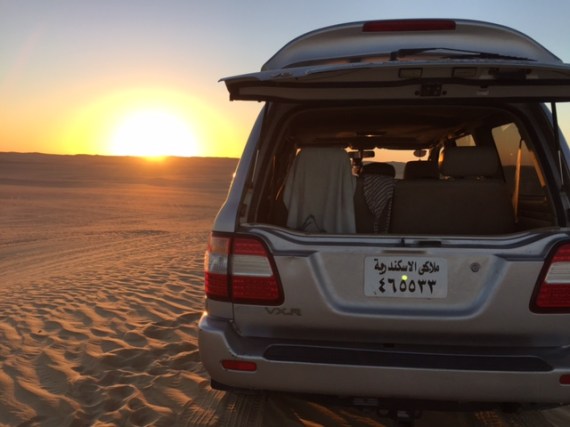
 Slouching mud and salt brick buildings provide storefronts (we were even able to buy a pair of fake Armani sunglasses), quaint restaurants and charming hotels and B&B’s.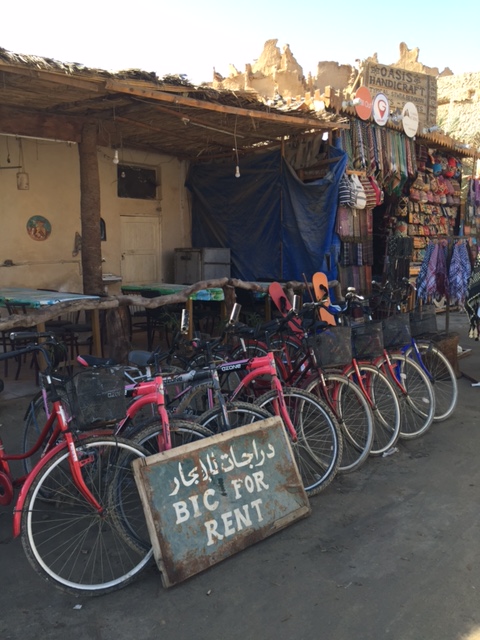

 George Clooney Slept Here