Swimming with sharks in Fiji’s Beqa Lagoon

About the only thing more controversial right now than Mitt Romney and Bain Capital are sharks, the fright-inducing predators perched at the top of the ocean food chain. Not only did a Great White nicknamed Brutus make quick work of a 24-year-old Western Australian surfer recently, but the government of China this month, kowtowing to sign-carrying protestors in shark costumes, officially banned from state dinners shark fin soup, long considered a symbol of wealth and prestige.

As much as I support that decision (activists claim the appetite for the gelatinous soup fuels the killing of some 73 million sharks a year), I wasn’t sure I wanted to come nose to nose with a fish that has seven rows of flesh-tearing teeth. In fact, when our Fijian dive caption first announced that my daughter and I would be snorkeling Beqa Lagoon’s Shark Reef Marine Reserve, my initial reaction was to become as neurotic and overly-protective as Marlin in “Finding Nemo.”

Sure, I took appreciative glances at the sprawling sea fans, the orangutan crabs and the neon bright schools of fish that live in this 40-mile ring of reef formed from an extinct volcano crater, but I couldn’t help but nervously look back over my shoulder every time a shark whizzed by like a slingshot-launched Angry Bird.

Most of the sharks were three or four feet long, small enough to fend off with a punch to the old kisser if the need should arise, but every now and then, an 8- or 10-foot monster blacktip or silver tip swam by, rendering me into a blubbering idiot, barely more useful than Ellen DeGeneres’ Dory with her nosebleed and short-term memory loss.

I had to keep reminding myself of the dive captain’s assurance that Great Whites are not among the eight species of sharks that frequent the famed soft coral of Beqa Lagoon and that Scarface, the 18-foot tiger shark that fancies the fish attracted by the dive boat’s chum, is practically as tame as Lassie.

Shark Reef is one of nearly 100 dive sites in the 100 square miles that make up Beqa Lagoon, a diver’s paradise off the windward side of Viti Levu, the largest of Fiji’s 300 islands. The barrier reef off the western edge is one of the world’s largest and the shark sanctuary with its famed bull sharks, tawny nurse sharks, whitetip, blacktip and grey reef sharks, sicklefin lemon sharks, silvertips and tigers is as open as Kathy Lee Gifford during her Regis days. No cages. No special gear. Just you and Scarface doing water ballet.

As exhilarating as it is to swim with sharks, I have to admit I was even more jazzed when Taz and I climbed up the boat’s ladder, missing nary a limb, for our return to Royal Davui, the secluded island resort where we were staying.

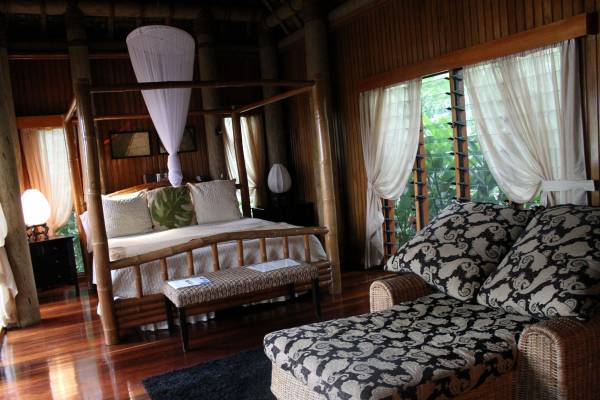
The Fijian name for the lush, beach-rimmed island that makes up Royal Davui is Ugaga (don’t even try to pronounce it. The Fijian language is anything but phonetic) and, after being tossed around from tribe to tribe (one chief would give the island to another chief who would reward yet another chief for protecting his village), it was finally in 2004 turned into the Clint Eastwood of romantic resorts. That is to say Royal Davui has nabbed pretty much every award you can get (from Trip Advisor to Conde Nast) for being one of the world’s most romantic destinations.

Not only do you get the whole 10-acre island to yourself (well, you and a handful of other guests), but each of the resort’s 16 vales, perched on the edge of the island with knee-weakening views of the coral reef, is secluded and intimate. Although we, as a mother/daughter team, didn’t imbibe, honeymooners and others so romantically inclined can enjoy private meals on their balconies, midnight skinny dips in their own personal plunge pools and teams of massage therapists who happily set up tables in their spacious outdoor living room overlooking the crystal clear Pacific.

Every morning at breakfast, a joyous affair under the restaurant’s monstrous banyan tree, we were presented with the entire day’s menu and asked to plan our gastronomic day. The menu is customized daily depending on which fish and fresh produce, 90 percent of which is locally sourced (which means it comes from either Pacific Harbour or one of the 11 villages on Beqa Island), happens to be available.

Despite the ooh-la-la food and views and stunning accommodations, the best part of Royal Davui is the staff, each of whom knew us by name, willingly dropped whatever they were doing to teach us how to play Sequence, one of the resort’s many board games, and invited us to join a nightly volleyball game, known familiarly as Fiji vs. The Rest of the World. On other nights, we enjoyed crab races, coconut shows and kava ceremonies.

Turns out being stranded on an island in the middle of shark-infested waters is not a bad way to spend a vacation. Unlike Gilligan and his crew who spent three seasons hatching plans to return home, we considered hiding when the boat came to return us to Viti Levu, and will likely spend the rest of our life figuring out how to get back there.

Presidential meet and greet at Fiji’s Outrigger on the Lagoon

The odds of my meeting Barack Obama are roughly the same as my chances of getting a meeting with NBC or Harvey Weinstein. And believe me, I’ve tried. Living in Kansas, I don’t exactly run into a lot of potential buyers for my TV series about a Missouri ecovillage.**

Contests for dinners (which I did enter) with George Clooney and Sarah Jessica Parker aside, I probably won’t be dining with our illustrious head of state anytime soon.

But in Fiji, a South Pacific island nation with a population of less than a million, I not only met the Fijian Head of State, but I was able to congratulate him on his initiative to ban plastic bags on Fiji’s tourism-heavy Coral Coast. Me!!?? A travel writer from Kansas!!

Ratu Epeli Nailatikau, who was inaugurated November 2009, three years after yet-another news-making coup, was dining next to my daughter and me at Ivi, a gourmand’s dream restaurant at Outrigger on the Lagoon. I’d already spotted the handsome politician and his security guards when they checked in right after we did at this busy Coral Coast resort. Not that it took much sleuthing. How could you miss three burly guys wearing skirts? Called sulus, these sarong-like garments are popular fashion statements for women and men alike.

Totally wrapped up in Ivi’s over-the-top tableside presentations (who knew you could even put 16 ingredients in a Ceasar salad?), I wasn’t paying attention when Outrigger GM Peter Hopgood first brought the Ratu over to our table for introductions. Luckily, I was quick enough on my feet to make the appropriate hand shakes and small talk to the former general, diplomat and Oxford scholar who now heads the 330 some islands (depends on the tide) that make up the Republic of Fiji.

He was as gracious and as open as all the other Fijians I met on my ten-day trip to this enchanted South Pacific nation. That he was hobnobbing with Coral Coast tourism officials is no big surprise. Tourism makes up more than a third of Fiji’s GDP, mostly Australian and Kiwi sun-seekers, and politicians have little choice but to accommodate the hotel industry that employs a large chunk of the population.

The military coups that seemed to occur like clockwork every three or four years did put a sizeable dent in tourism dollars, but Commodore Frank Bainimarama, who masterminded the last two coups, promises democratic elections in 2014 and tourists seems to be frenetically booking rooms, diving trips and destination weddings.

At Outrigger, while the President was congratulating anti-plastic poster drawing school kids, I do’s were being repeated, hair was being braided, golf was being played, spears were being thrown, tiki torches were being lit and cellulite was being jiggled in pool aerobics as it was at hundreds of other resorts across the Fijian archipelago.

Even the President himself, after an arduous day of official duties, ended up at Outrigger’s Vakavanua Lounge where he drank red wine, sang karaoke and announced to his fellow Money for Nothing-blaring singers that if the elections don’t swing his way in 2014, maybe he’d start a band and take his act on the road.

Good luck, Ratu, and thanks for making a celebrity-starved Midwesterner’s holiday.

**The quirky dramedy, called Occupy, follows six 20-somethings who live at Milagro Springs, a sustainable community/retreat center. I jokingly call it Sex and the Country, if anyone’s interested.

Tale of Three Spas

Who doesn’t love a good success story? Especially when it’s the little guy who knocks down the Goliath. Early this year, bath and body products made in a tiny South Pacific country with less than a million people made the list of the world’s top 10 spa products.

Photo by Taz Grout

Yes, I’m talking Pure Fiji, whose lotions, oils and shampoos are used by such celebrities as Nicole Kidman, Kate Winslet and even Eddie Murphy. Pure Fiji is not only a South Pacific success story, but it’s a shining example of what’s possible.

Gaetane Austin, who started the family-run company 12 years ago on her kitchen table in Suva, the Fijian capital, has stayed true to her principles–using only sustainable ingredients, buying from local villages, insisting on eco-friendly packaging and, in the process, promoting rural community development.

So on my recent trip to Fiji, I decided it was high time to try out some of the Pure Fiji products. But, even more importantly, to enjoy a few of the resorts and spas where the products are used.

Here’s my report from three of Fiji’s best:


Namale Resort and Spa.
The slogan for this remote resort on the Koro Sea is “Separate Yourself From the Rest of the World.” It’s no exaggeration. Of Namale’s 325 acres, 200 are protected rainforest and each of the bures (Fijian cottage) was locally handcrafted (the only power tool being a drill to anchor fittings into the lava outcroppings) with native hardwoods, floor-to-ceiling windows, thatched roof and infinity pool.

Photo by Taz Grout

Tony Robbins, the self-help guru who turned the former coconut plantation into the five-star haven, aptly describes it as “killer plush.” It has everything from its own private waterfall to one of the best fitness centers in the South Pacific. It even has a gorgeous hardwood basketball court, a digital golf driving range and a two-lane, ten-pin bowling alley where you can bowl sans shoes.

From the hydro-aromatherapy room of the 10,000-square-foot spa (you can’t miss it. Just look for the smiling giant Buddha out front), you can dreamily gaze out over the Koro Sea, and if you’re lucky, catch a glimpse of spinner dolphins, batfish and the resort’s signature blowhole. As Robbins likes to say, “At Namale, the real you can’t help but show up.”

Here’s to hoping this is the real me. When my daughter and I arrived from the nearby tiny one-strip airport (no air traffic control, just locals shooing cows off the runway), we found our carved names (one of Namale’s many special touches) hanging from the door of the 2500-square foot Dream House. Suffice it to say, it was bigger and far better appointed than my digs at home with outdoor showers, two pools, its own kitchen and maid quarters, a couple hot tubs and a giant projector that pulls down in front of the 200-foot windows on which we were able to watch The Bachelorette episode that was filmed there.

The Spa in the Sky. Located on the Coral Coast’s Heavenly Hill, Bebe Spa Sanctuary offers gorgeous panoramic views of the coast and surrounding jungle from each of its seven treatments rooms. This $3 million spa, a short golf cart ride up the hill from the Outrigger on the Lagoon, offers all the traditional treatments (plus a lot of non-traditional treatments such as myoxy caviar facials and green coffee body wraps) as well as free yoga and meditation classes.

It also offers waxing, henna and Bo Derek-style braiding, a “do” seemingly chosen by all 242 tweens swimming in the resort pool. The spa’s treatment rooms, which are thankfully off-limits to kids, are suspended from the main structure and have private balconies, open-air showers and/or sunken spa baths and have won the spa’s architects kudos for innovative design.

As for the Outrigger on the Lagoon, it offers a two-page sheet of daily activities from coconut shows to free scuba diving lessons to pool aerobics and a butler who delivers free champagne and canapés to your room every night.

With seven restaurants, this five-star family resort wows in the culinary department. In fact, executive chef Shailesh Naidu was recently named president of the Fijian Chefs Association, an honor richly-deserved judging by the tableside presentation at Ivi, the resort’s most formal offering where I happened to be seated one table away from Ratu Epeli Nailatikau, the Fijian president.

Some enchanted island. Royal Davui, an exclusive, family-run island resort in Beqa Lagoon, is the Jack Nicholson of romantic resorts. That is to say it has nabbed pretty much every award you can get (from Trip Advisor to Conde Nast) for being one of the world’s most romantic destinations.


Not only do you get the whole 10-acre island to yourself (well, you and a handful of other guests), but each of the resort’s 16 vales, perched on the edge of the island with knee-weakening views of the coral reef, is secluded and intimate. You can enjoy private meals on your balcony, midnight skinny dips in your own personal plunge pool or a duo of massage therapists who will happily set up tables in your spacious outdoor living room overlooking the crystal clear Pacific.

The spa, like the island itself, is small and intimate, but it’s huge in stature and quantity of available treatments. Try the Dilo Rescue Wrap if you find yourself getting too much sun on one of the island’s sailing, kayaking, snorkeling or diving trips.

Every morning at breakfast, a joyous affair under the restaurant’s monstrous Banyan Tree, you’ll be presented with the entire day’s menu. It’s customized daily depending on which fish and fresh produce, 90 percent of which is locally sourced, happens to be available.

Despite the ooh-la-la food and views and stunning accommodations, the best part of Royal Davui is the staff, each of whom knows you by name, will drop whatever they’re doing to teach you how to play Sequence, one of the resort’s many board games, and will invite you to a nightly volleyball game, known familiarly as Fiji vs. The Rest of the World.

Unlike Gilligan and his crew, you will not want to leave Royal Davui’s Ugaga Island (don’t even try to pronounce it. The Fijian language is anything but phonetic) and will spend the rest of your life figuring out how to get back there.

Flights to Fiji are available on Air Pacific.

Imagine if Justin Bieber’s fans rechanneled their love

If only we could channel the passion of Justin Bieber’s fans into something useful. Not that there’s anything wrong with the 18-year-old Canadian’s R&B music. But just think what these 13- to 19-year-old girls could accomplish if they turned the sheer energy of their Bieber lust onto a world problem. We’d have no poverty, no hunger, no disparity of any kind.

The lengths to which these nubile young Beliebers, as they’re called, go to proclaim their love for the moptop star could move mountains. At London’s Royal Garden hotel, a posh hotel overlooking Kensington Palace, Hyde Park and St. Paul’s Cathedral, thousands of young fans camped out, skipping school, starving themselves to keep their place in the Bieber viewing queue.

Even though the ritzy hotel is pedigreed in hosting stars from Sonny and Cher and the Monkees to the London Rugby team, Biebster’s fans and their 2000 plus phone calls (claiming to be everyone from his long lost cousin to his personal stripper) jammed the phone lines, forcing the five-star hotel to change its phone number. That unbridled passion could be used to insure health care for all Americans, something their Canadian crush has consistently applauded.

At another London hotel a few years ago, a couple enterprising Beliebers snuck inside the employees’s entrance and pirated a couple maid’s uniforms before they were nabbed dutifully snapping pictures inside the Paul McCartney suite at Liverpool’s Hard Days Night hotel where their idol was staying. Again, if that persistence was used to feed the hungry or stop the Syrian government’s bombing of innocent neighborhoods, the world would be a much nicer place.

The more than 300,000 screaming, purple-wearing (allegedly his favorite color) tweens who stood in the rain for the pop star’s June 11 Mexico City concert could have easily moved their ardor to Los Cabos’s G-20 Summit a week later and put some genuine teeth in the “tax and entitlement reform” act.

Mr. Bieber, I would love you, too, if you could just get the unbridled passion of your 20 million twitter fans pointed in a more productive direction.

Key West Hotel doubles as inspiring botanical garden

If you read 1000 Places to See Before You Die back in 2003 when it first came out, you could be well on your way to the halfway mark. Maybe you’ve already checked off Robert Louis Stevenson’s home in Western Somoa, La Scala in Italy and the Great Wall of China in well, China.

As for me, I haven’t made so much as a dent in the list, but I did have the pleasure of not only seeing one of the esteemed places on Patricia Schultz’s list, but in staying there for two amazing nights. I’m talking about The Gardens Hotel in Key West.

It made the famous list because it’s gorgeous and unique and because Peggy Mills, the eccentric owner who started the place back in the 1930’s, had the foresight to buy property, not so she could milk it for its commercial potential, but so she could plant more and more tropical greenery. Nearby properties would go up for sale and the avid gardener would snatch them up to plant more orchids and cannas and royal poinciana and breadfruit trees. She was successful in obtaining permits to collect plants from every continent on the planet.

Eventually, Mills sprawling garden became the largest private estate in Key West which is what it might still be today except that in 1968 the Chamber of Commerce convinced her to give tours. After all, they argued, her private home could challenge any public botanical garden in a fistfight.

Mills’ hard work is still on display today, in a peaceful, charming oasis only a block’s stumble from Duval Street. The lushly-landscaped Gardens Hotel has 17 guest suites, a pond with real turtles, a courtyard, chirping birds and winding brick paths that lead by ancient statuary, serene sitting areas and enormous one-ton earthenware jars (they’re called tinajones) that Mills manage to wrest from Cuba thanks to a family friendship with Batista. Don’t ask!

This stunning boutique hotel also serves breakfast every morning, a delicious al fresco affair in the courtyard, has a very unique, serve-yourself wine bar and features live jazz every Sunday. Plus, it wins brownie points in my book for being the first hotel in Florida to be certified green with the Two Palm designation from the Florida Green Lodging Association.

Patricia Schultz isn’t the only one to recognize The Gardens Hotel. The New York Times named it the “prettiest hotel in Key West.” Travel+Leisure included it in their top 21 favorite beachside hotels. And HGTV filmed an episode there.

But my favorite part was that staff gardeners are insuring Mills’ legacy by cheerfully giving away fallen seeds, encouraging guests to start their own botanical wonderland back at home. I squirreled away a couple sandalwood seeds that look an awful lot like red hots.

When Mills was laying the nearly 100,000 bricks she imported from Cuba, Honduras and England, she found coins and jewelry buried on her property, former pirate booty that she liked to call her “buried treasure.”

Little did she realize that the real treasure was the botanical paradise she was creating for the rest of us.

Key West, nirvana for writers

If you’re a writer, Key West is on your bucket list, likely in the number one spot.


This bohemian island city, the southernmost in the United States, is where Ernest Hemingway
produced nearly half his life’s work including To Have and Have Not and For Whom the Bell Tolls. It’s where Tennessee Williams wrote Streetcar Named Desire, supposedly while listening to Billie Holiday records, and where he partied with Truman Capote, James Leo Herlihy and Thomas McGuane.

This two- by four-mile island that’s nearer to Havana than Miami is said to have more writers per capita than anywhere including 13 Pulitzer Prize winners. Whether drawn by the tropical climate or its famed zany hedonism, writers such as Ann Beattie, Annie Dillard, Robert Frost, Ralph Ellison, John Dos Passos, Judy Blume, Shel Silverstein and Elizabeth Bishop are just a few whose names have appeared on Key West mailboxes.

If you’re truly ambitious, your bucket list contains the hope to be an invited presenter at the prestigious Key West Literary Seminar, held every January since 1983. Or your list could be like mine, just wanting a little recognition for your wild-ass dream to make a living doing what you love.

When I visited Key West in the early 1990’s, I had already written a couple books, but hadn’t yet convinced a publisher they deserved airing. I’ll never forget gazing reverentially at the second-floor studio behind Hemingway’s Whitehead house, the place where he wrote every morning whether hung-over from a night of hard-drinking with Sloppy Joe Russell or sore from a dust-up with Wallace Stevens. I remember feeling giddy, inspired, thinking to myself, “Someday, like my fellow Kansas City Star alum, I,too, will be recognized for my words.”

So when I went back to Key West last month to celebrate the anniversary of its April 23, 1982 secession from the union, a raucous reenactment complete with parades and water balloons of the day the city declared itself an official nation–The Conch Republic–in protest of the roadblock that was deterring tourists, I couldn’t resist returning to Hemingway’s home.

The six-toed cats, heirs to Hemingway’s beloved “Snowball,” a gift from a Cuban sea captain who believed the extra toes brought good luck, still roam the one-acre grounds. Pictures of his four wives still hang in the parlor. And, of course, the studio with his leather writing chair, his books and his typewriter still looks as it did between 1931 and 1938 when he was there every day pounding the keys.

But this time, as I descended the steps leading to and from the famous studio, it suddenly hit me. The vow I made 20 years ago had come true. Fifteen times, in fact, I’ve signed a contract with a publisher who believes in my work.

I noticed a certain bounce in my step and as I looked up at Key West’s clear, cerulean sky, gave a nod and a grateful, “Thank you, Papa.”

Now, if I can just get the Key West Literary Seminar to call.

Reinvent yourself in the Florida Keys

The Florida Keys, a necklace of coral islands stretching 127 miles from the tip of the Florida peninsula, epitomizes the art of reinvention. Not only have the Keys and the people who live there survived countless floods and hurricanes, including three that finally put the kibosh on Henry Flagler’s Overseas Railway that connected these free-standing tropical islands to the rest of the country, but they’ve managed to do it all with an uncommon panache.


Pilgrims from other places end up here with a dream to try something new and the cojones to create a whole different reality for themselves.

Take Joe and Ronnie Harris, for example. New Yorkers through and through, they worked for NBC until Joe, on a diving trip to Key Largo, turned around and saw what he called the world’s most beautiful sunset. That was in 1991 and, before he was able to regain his senses, he was the proud owner of a small beach and the 11-room hotel that fronted it.

And since what’s a Florida hotel without tropical greenery, he and Ronnie, his eventual wife, started buying plants, so many that they noticed their two-acre property had morphed into a botanic garden.

Today, Kona Kai Resort still features nightly, knee-weakening sunsets, but Joe and Ronnie watch them under the tropical fronds of their very own botanic garden, a 501c3 non-profit complete with an ethnobotanist, educational programs and tours of their more than 250 species of plants.

Joe, who has been known to say that “plants are people, too,” sees this as his new life mission.

On the tour, led daily by Rick Hederstrom, a bright, eager young ethnobotanist straight from London’s Kew Gardens, I learned that West Indian mahogany contains catechin, an anti-oxidant that reduces the risk of heart disease, that the seats of Henry Ford’s first Model T’s were stuffed with Spanish moss and that if you place the top of a pineapple in your backyard garden, it’ll eventually grow into a pineapple bush — if you happen to live in the appropriate climate. With the plants in this botanic garden, I could have waterproofed a blow gun, plucked a needle used in Haitian voodoo or temporarily stunned some fish, making them easier to catch.

My main thought while on this tour is was why can’t every kid in America see this. Maybe they’d realize there’s more to life than the tiny screens they worship.

Kona Kai also has an art gallery, topped only by that sunset that I enjoyed while munching on Jamaican cherries, star apples and other exotic fruits grown right there in the Botanic Gardens at Kona Kai.

2012-05-02-keylargochocolates.jpg

While in the land of reinvention, I also met Bob, a former pilot from Arizona, and Kristie Thomas, a former travel agent from Wisconsin, who have taken another plant — cacao — and turned it into some of the best truffles and chocolates this side of the Atlantic. The duo, who met a few years ago when Christie’s sailboat was hit by lightning in Brunswick, Georgia, poured their entire retirements into Key Largo Chocolates, a booming concern that, in less than a year, has already grown out of one location. Their slogan, “Nobody knows the truffles I’ve seen” is only topped in creativity by their pastel pink and green shop at mile marker 100.5 that turns out such handmade concoctions as three-dimensional chocolate seashells, key lime pistachio bark, key lime truffles and chocolate-covered wine bottles.

Suzanne Holmquist, a former producer for the BBC, resurfaced in Key Largo after marrying an American engineer and boat maker. They recently added the African Queen, the 100-year-old steam boat used in the 1951 movie of the same name, to their fleet. Even though the celebrity vessel is registered as a national historic site, it had fallen into disrepair after its previous owner, a Humphrey Bogart enthusiast, died in 2001. After a six-month, $70,000 restoration, the African Queen is now back plying the waters of the Florida Keys. And as for Holmquist, she and her husband run Calypso Sailing Company, a fleet of tall ships, out of their bullet-ridden home (it was once used in a stakeout of drug runners) in Marina Del Mar.

2012-05-02-africanqueen.jpg

Further down the Overseas Highway, at mile marker 48.5, I witnessed yet another reincarnated career. Richie Moretti ran a successful Volkswagen dealership in Orlando before buying a little mom and pop hotel in Marathon that was going into foreclosure. He rescued it, running it as the hotel it had been since the 1940s.

Its salt water pool, almost a redundancy sitting next to the ocean, eventually became an “inn” for rescued ocean creatures. First there was a tarpon, then a school of tarpon, a Goliath grouper, some lobsters and eels. In the mid 1980s, when Teenage Mutant Ninja Turtles were all the rage, the school kids who came to the motel on field trips kept asking Moretti “where are your turtles?”

They sure couldn’t miss them now. The entire motel has been converted into a rescue operation for injured sea turtles. Moretti even bought the nightclub next door for use as a hospital, complete with operating rooms, doctors (well, veterinarians) and a couple ambulances. Since it opened in 1986, Moretti’s Turtle Hospital, the only such facility in the world, has rescued more than 1000 turtles, releasing most back to their ocean homes after propeller injuries, flipper amputation and the removal of viral tumors caused by the fibropapilloma virus that affect 50 percent of the world’s sea turtles.

So watch out if you’re heading to the Florida Keys. It might just inspire a whole new life.

St. Bart’s: the perfect Caribbean island to exhaust a trust fund

Being a parent changes everything. While most celebs pick Christmas and New Year’s to visit St. Bart’s, the posh Caribbean magnet for all things chic, Beyonce and Jay Z headed to the eight-square-mile island to celebrate Easter. It was three-month-old daughter Blue Ivy Carter’s first big vacation.

Not that the proud parents didn’t sneak in some alone time. They spent a day sunbathing at Ansse de Grande Saline, an isolated half-mile beach where development, at least for now, is verboten.

It’s one of the tiny island’s 17 beaches and to get there, B and J had to scramble over a sand dune and hope the anole lizards didn’t take a hankering to the drinks they sipped from coconut halves. After all, they only wanted to soak up some powder white beach time without a diaper bag.

Easter holidays in St. Bart’s certainly wasn’t the celebrity couple’s first trip to this secret little French paradise where the ruling families, descendants of the original 17th century settlers, purposely keep prices high, limit the size of the airport and import everything from France. Homes, even modest ones without a beachfront, can cost upwards of $7 million which is why you’ll find such names as Steve Martin and David Letterman on St. Bart deeds. Jimmy Buffet, also a St. Bart’s homeowner, supposedly wrote “Cheeseburger in Paradise” at Le Select, a nondescript, but fabulous restaurant (Mick Jagger has entertained there), one of many wedged in between the Hermes, Gucci, Cartier and other high-end shops.

No, B and J are what you might call “regulars.” In 2009, in fact, Beyonce performed a controversial New Year’s Eve show at a Nikki Beach party thrown by Muammar Gaddafi’s son. In the audience were Usher, Lindsay Lohan and Microsoft founder Paul Allen whose 416-foot yacht, Octopus, can often be spotted at Gustavia Harbor.

During the notorious holiday party season, when Beyonce and Jay Z were a little tied up with the impending birth, rooms at the handful of hotels leap in price ten times over. A week at a villa can run up to $150,000. A long-time resident described the season as “summer camp for wealthy, well-known New Yorkers, business tycoons, music stars, and Hollywood celebrities.

“It’s like the whole island is Studio 54 at its peak,” he said.

In recent years, the hottest, most over-the-top New Year’s bash has been thrown by Russian oligarch Roman Abramovich. Price tag? More than $7.8-million, but what do you expect when you fly in such entertainers as Prince, Gwen Stefani and the Black Eyed Peas? The Red Hot Chili Peppers rang in the 2012 party that was held as his $90-million Gouverneur Bay Estate, the same estate once owned by the Rockefellers. On the 400-name guest list? Jon Bon Jovi, Marc Jacobs, Harvey Weinstein, George Lucas and Martha Stewart, to name just a few.

Abramovich’s yacht, the world’s largest private yacht, measures 536 feet, has two helicopter pads, two swimming pools, a submarine and 80 onboard staff.

St. Bart’s, also known as St. Barths and St. Barthelemy, sits across from St. Marteen/St. Martin. It was originally discovered by Christopher Columbus and named after his brother, Bartolomeo.

Now go spend that trust fund?

All-natural beauty products made fresh daily in Sheboygan, Wisconsin

Someone needs to tell Caitlin Brotz that she could get a lot more than $12 for the anti-aging serum she developed from pomegranate, blackberry and carrot seed oil.

After all, the big guns–the Lancomes and Crème de la Mers and La Prairies–charge up to hundreds of dollars per ounce for their anti-wrinkle creams.

“I always have to chuckle at their prices,” says the 30-year-old creator of Olivu 426, an all-natural beauty products business she runs from a small storefront in Sheboygan, Wisconsin. “I know exactly what goes into their products and the mark-up is insane. And I know good and well we could get a lot more for our products, but I chose not to go that route.”

But don’t let the meager price tag fool you.

“The reason our anti-aging products make up a good 30 percent of our business is because they work,” Brotz says. “We make everything fresh daily and use nothing but all-natural products.”

One of her most ardent fans, a 50-something teacher, decided to pit Olivu 426’s Night-Time Repairing Serum against a popular Lancome product. For a month, she applied Olivu 426 to the left side of her face and Lancome to the right.

“She appointed her husband as judge,” Brotz says. “Not only did our product win hand’s down, but her husband was so impressed, he now uses our products, as well.”

Men in Sheboygan, she says, don’t like to admit they use “product,” but thanks to the influence of Brotz’s newly-minted husband, a semi-professional football player who uses Olivu 426 to control acne caused from sweating in his football helmet, they’re starting to embrace the more than 120 products offered by Olivu 426.

Indeed, it was a male athlete who inspired Brotz to start making all-natural beauty products in the first place. When she was 22, her then-boyfriend, a semi-professional snowmobile racer, was building a track out of wood chips. When it accidentally caught on fire, he was burned on 60 percent of his body and life-flighted to Milwaukee. Because his body (and the resulting skin grafts) could no longer tolerate lotion with alcohol, Caitlin started researching all-natural products with healing properties.

The 426 in the business name, in fact, was Adam’s snowmobile number.

The other unique feature of Olivu 426 is that customers to the tiny 700-square-foot storefront are invited to make their own products, start to finish.

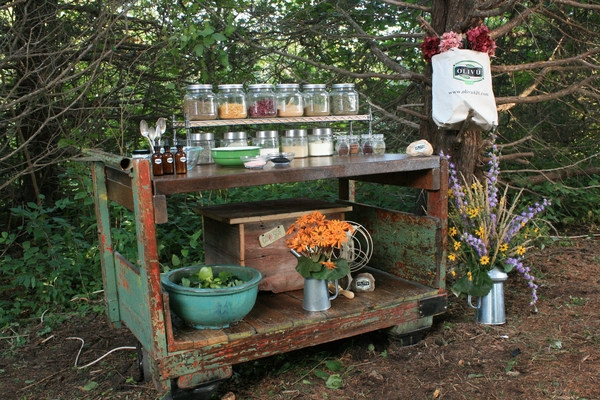
Just like paint-your-own pottery that spread across the country a few years ago, Olivu lets amateurs create such products as avocado whip lotion, emu oil body wash and lavender hydrating face mist. Or they can make lip balms, sugar scrubs, lotions and even insect repellent. The hard part is choosing which of the 150 types of herbs, scents and essences to add to their potions.

“We have everything from tomato leaf (it smells like a juicy Tuscan tomato) and orange Satsuma to baby powder and Brazilian water lotus,” she says. “But oatmeal milk and honey is probably still our most popular. It’s great for people with sensitivities or allergies or for those who can’t tolerate much of a scent.”

As far as she knows, Olivu is the only place in the world that offers customers that make-your-own option.

“Oh, there are places you can go and add your own scent, but our customers get to do it from start to finish right in our own test kitchen using the same blenders we use,” she says.

Eventually, she’d like to franchise the make-your-own aspect that is highly-popular with the Wisconsin bachelorette party set.

Right now, she’s focusing on growing the internet business that makes up a good third of her business.

“People visiting Sheboygan stumble into our store and get hooked, particularly on the anti-aging serums,” she says, adding that she has regulars from across the country and as far away as Japan.

“I didn’t even think about that when I put up the website,” Brotz laughs now. “I hadn’t stopped to consider overseas shipping.”

All, I have to say, Caitlin, is you better get ready. Olivu 426 is going to be huge.

Olivu 426, 511 N 8th Street, Sheboygan, WI 53081, 920.783.0809.

Kramer, Betty Ford and Ansel Adams all caught at the same Portland hotel

When your room key features a black and white photo of Betty Ford dancing on the Cabinet Room table, you have to figure you’re probably not in an ordinary hotel. Other hints would be the spiritual menu that dispenses every religious literary work from the Talmud to the Koran. Or the 36 by 48-inch portrait of Michael Richards (Seinfield’s Kramer) hanging outside your door.

Yes, I’m at the Hotel Lucia, the downtown Portland boutique hotel that doubles as an art museum. I’m here, not to gawk at Hotel Lucia’s art, though I certainly did, but for the rare opportunity to take in a Mark Rothko retrospective at the Portland Museum of Art.

Not many people know this about the artist whose color-saturated abstract paintings made him so famous, but he grew up here (after immigrating from Russia with his family) and took his first art class here. In fact, his first one-man show, staged in 1933 long before his paintings were selling for tens of millions of dollars, was curated at the very museum hosting this current show, 45 pieces that trace his work from the late 1920’s until shortly before his 1970 suicide.

Curator Bruce Guenther assembled the impressive exhibit from private collections, museums, the National Gallery of Art and Rothko children that famously sued to reclaim the nearly 800 paintings in his estate. They were successful in securing the return of all but 100 paintings including Homage to Matisse that sold in 2005 for a record $22.5 million and White Center (Yellow, Pink and Lavender on Rose) that broke that record two years later, selling at Sotheby’s for $72.8 million. The exhibit moves from his early figurative works to the brooding subway series he painted for the WPA to the transcendent abstractions that created his legacy.

That Hotel Lucia is running a special Rothko promotion is not a big surprise. It has, after all, developed quite a reputation with its permanent exhibit of 680 black and white photos from the portfolio of another Portland original, Pulitzer-prize winning photographer David Hume Kennerly. In every corridor, guest room, bathroom and even elevator, Kennerly’s stunning photographs tell the story of American politics from Nixon on. In fact, it was a bit disconcerting sleeping in a bed so close to Dick Cheney and Leonid Brezhnev. Luckily, Kramer and Ansel Adams were there to weigh in. Even the 24-hour fitness center and the business office where I printed out my boarding passes showcased art, colorful pieces by Portland artists Mike Russo and Gregory Grennon.

One of my favorite features of Hotel Lucia is their “Get it Now” button. That means that, even if it’s 3 in the morning and you’re craving khao ka moo (a Thai dish involving stewed pork leg, for those who have never craved it), all you need do it push the button and voila!, they’ll figure out a way to make it happen. Which is another reason this hip and sassy boutique has a dedicated clientele of Hollywood and music stars. Although my lips are sealed as to who wanted what, here is a short list of “Get it Now” requests over the years: chocolate milk and Dom Perignon (at the same time), a fruit and vegetable juicer and an exotic, but legal mushroom, four unripe mangoes (don’t ask), a separate room for the luggage, 24-hour dog sitting and a TV mounted on the ceiling.

The other worth-mentioning feature of Hotel Lucia is the amenities They’re all local (I like that in a hotel) from Portland’s own Mada bath goodies to Portland Roasting coffee and Smith teas.

Included in Lucia’s Rothko promotion are tickets to the Portland Art Museum, a $20 certificate to the museum’s gift shop and two “Red on The Rocks,” colorful cocktails inspired by Rothko’s paintings.

The Rothko respective runs through May 27 as does Hotel Lucia’s “Rothko in Retrospect” package. To book, call 866.986.8086 or visit www.hotellucia.com.